On-demand class with Pia Kynoch
Your nervous system reads your body every moment.Fascia is much of what it reads.
Stress isn't a mood, a mindset or a weakness to push through. It's your nervous system's report on whether you're safe enough to thrive, or braced hard enough to simply survive. This class follows that report from the connective web that holds your shape, through your gut, breath, tongue and feet, to the brainstem that decides what happens next. And it shows you how to change what the report says.
If you've been managing these one at a time
These look like separate problems because separate specialists manage them. Physiologically, many of them are read-outs of one upstream state: a body that hasn't yet received a credible signal of safety.
And much of what keeps that signal from arriving isn't in your head at all. It's in how your body is holding itself, right now, all day, without you deciding to.
The vagus nerve is a reporting line, not a control cable
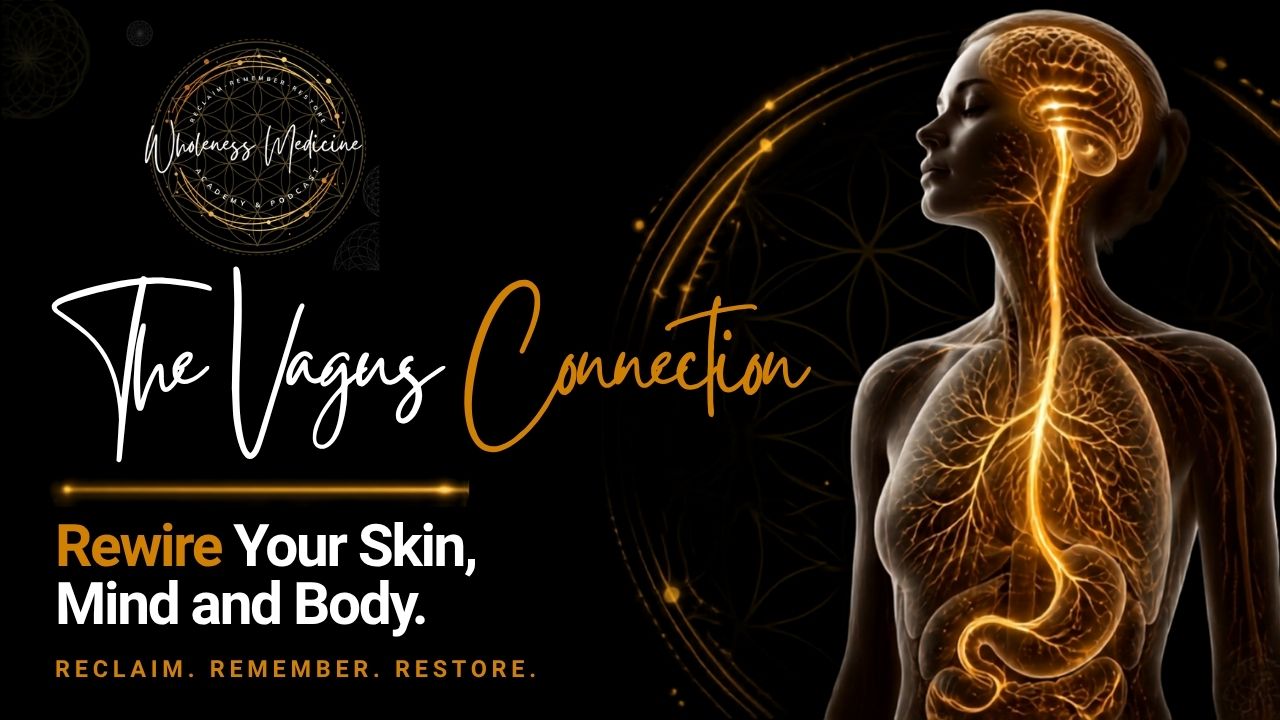
Around 80 per cent of its fibres travel upward, from body to brain. It reports. It does not instruct.
That single fact changes almost everything we've been told about calming the nervous system. The vagus is constantly carrying news about your gut, your blood vessels, your breath, your immune activity and the state of your tissues to a desk in the brainstem, where it's sorted and used to predict what you're about to need.
It carries no information about your history or your story. Only about what your body is doing now. Which raises the question this class is built around: what, exactly, is it reading?
Why fascia changes the whole conversation
Fascia is the connective tissue that wraps and runs through every muscle, organ, nerve and vessel in your body. For most of the last century it was taught as packaging. It isn't.
It's a sensing organ
Densely supplied with sensory nerve endings, it's one of the main things your nervous system listens to.
It never stops reporting
A meal, a conversation, a bright light all come and go. The shape you hold is the one input that signals all day.
It's mostly water
Movement is what moves water through it. Stiff, dehydrated tissue doesn't just move worse. It reports worse.
It holds your history
Protective patterns set early, or under strain, become structural. That's why you can't reason your way out of a posture.
What the class covers
A taught sequence, not a grab-bag of tips. Each part builds on the one before, and by the end you'll see why they were never separate subjects.
- 1
The reporting line
What the vagus reads, where its reports land, what its smaller outgoing arm actually does, and the four separate things that decide whether its calming message ever arrives.
- 2
The shape you hold
Fascia as one continuous web, mostly water and densely innervated, and the research exploring how it carries electrical, light and fluid signals. Why a held posture is the one input that reports all day.
- 3
Inherited before you arrived
The egg that became you began forming in your mother while she was still inside your grandmother. Maternal mitochondria, epigenetic marks, the microbiome, and the early reflexes that shape posture and arousal long before choice was possible.
- 4
How stress becomes structure
How sustained stress stiffens connective tissue, why the cells involved have no way to simply let go, and the loop that keeps it going long after the original stressor has passed. Why a pattern has to be re-loaded rather than corrected.
- 5
The repair schedule
Rebuilding connective tissue is one of the most energy-hungry jobs a cell does, and it runs to a timetable set by your circadian clock, vitamin D, mitochondria and microbiome. The same four govern every barrier you have: skin, gut, lungs, eyes and the vaginal lining.
- 6
Tongue, breath and feet
The deep fascial line from tongue to toes. Tongue posture, airway and sleep. The three diaphragms. A breathing muscle doing four jobs at once, including moving your gut and lymph. And your feet as the foundation your brain reads for safety.
- 7
The gut report
The specialised cells that connect your microbes directly to the nerve. Why disorders of gut-brain interaction now affect around four in ten adults worldwide, what modern life does to the gut barrier, and why a lining that renews every few days needs constant resourcing.
- 8
The door, the ledger and the crash
The stress switch in the brain that is held shut until something forces it open, and how the vagus reaches it. Adenosine as your daily energy ledger, what caffeine really does, and why chronic stress disconnects the body's own calming signal.
- 9
Changing the baseline
Interrupting a stress spike is not the same as shifting a stress baseline. What adult neuroplasticity actually requires, and how to give your system consistent signals of safety across many inputs at once. Guided practice is woven through the whole class.
Everything included
$97 AUD
Priced for access, not margin.
- The full class, on demandTwo and a half hours. Watch in one sitting or across a week, at your own pace, as often as you like for [ACCESS PERIOD].
- The illustrated guideFully referenced and tiered by how strong the evidence is, so you always know what you're standing on. Yours to keep.
- The resource bookletPractices to use on yourself, and adaptable for the people you work with. Yours to keep.
- Certificate of CompletionStating the topic and 2.5 hours of learning. Many associations let members self-submit non-accredited learning; check with yours.
If you work with your hands on other people
Whatever you deliver, whether skin treatments, bodywork, movement, nutrition, coaching or therapy, you're delivering it into a body that is either open to it or closed to it. Nervous system state is the gate on every other intervention's return.
The client who isn't responding. Whose results plateau for no visible reason. Whose skin won't settle, or whose tension returns by the next appointment. Very often that is a system in defence, and a tissue still shaped for something else, not a compliance problem.
This class gives you the mechanism to explain it credibly, and a way to design your work with your client's physiology rather than against it. It's just as relevant if you're a Pilates or yoga teacher, massage therapist, dermal or beauty therapist, naturopath, nurse, personal trainer, counsellor or dental professional.
And the part that tends to land closest to home: what you charge, whether you back yourself, how you hold boundaries, these are nervous system patterns too. They are learned mind-body pathways that can be rewired for thriving rather than just basic surviving.
If you're here for your own body
You don't need a diagnosis to deserve an explanation, and you don't need a clinical background to follow any of this. Everything is taught at the felt, personal level first, with the deeper detail clearly signposted so you can take it or leave it.
You'll come away understanding what your particular symptoms are reporting, where your body holds its patterns, and a set of practices that are free, immediate, and available to you without anyone's permission.
Said plainly
This is not a replacement for medical care. If you're unwell, keep your doctor. This is the layer underneath the medicine, rarely taught, and quietly setting the ceiling on how well everything else you're already doing can work.
Who's teaching
I'm Pia Kynoch, founder of Wholeness Medicine.
I'm a naturopath and dermal therapist with more than 30 years of clinical practice, and a teacher of yoga and qi gong. I teach systems biology to practitioners, and to people who simply want to understand their own bodies. My work sits where rigorous science meets lived, embodied practice, because either one alone is only half the picture.
This class draws on many years of formal study, including:
- Biology of Trauma. Two years of study, completing every module offered by the program.
- NICABM. Ongoing training with leading trauma and neuroscience clinicians.
- The Neuroscience Academy. Applied neuroscience and brain health for practitioners.
- Luis Mojica. Somatic and nervous-system-led approaches to healing.
- Epigenetics and attachment theory. How environment, experience and early relationship shape regulation across a lifetime, and across generations.
- Internal Family Systems and parts work. Working with protective systems rather than against them.
- Breathwork, yoga and qi gong. Embodied practice, taught here as physiology rather than ritual.
Alongside continuing study across fascia, microbiome science, circadian biology and quantum biology. The threads that keep turning out to be the same thread.
No product pitch at the end
Nobody is paying for this class to exist, so nothing is being sold inside it. No device, no supplement, no ingredient range waiting in the final ten minutes. That buys the freedom to teach this honestly, including the parts that are genuinely uncertain and the popular claims that don't survive a close look.
Everything is labelled by how well it's supported:
- EstablishedReplicated in humans. Teach it, use it, defend it.
- Credible hypothesisStrong mechanism, incomplete human evidence. Worth knowing, and named as such.
- Emerging frontierGenuinely new, genuinely interesting, not yet settled. Flagged clearly.
Questions people ask
How long do I have access?
Three months. The illustrated guide and resource booklet are yours to keep.
Do I have to watch it all at once?
No. Watch the full two and a half hours in one sitting, or work through it across a week. Many people find the practices land better when there's space between sections.
Do I need a science background?
Not at all. Every mechanism is taught at the recognisable, personal level first. The deeper detail is signposted, so you can go as deep as you want and skim the rest without losing the thread.
I'm a practitioner. Will this be too basic?
Unlikely. The class spends its time on the long causal chains most training skips: how stress becomes tissue structure, why the calming signal fails to arrive, and what actually shifts a baseline rather than a single spike.
Is this CPD accredited?
Not yet. You'll receive a Certificate of Completion from Wholeness Medicine stating the topic and duration. Many associations permit members to self-submit non-accredited learning; check your own association's rules.
Should I read the guide before watching?
Recommended, not required. The class opens with a recap so nobody is lost, but you'll get more from it if you've read the guide first.
Is the somatic work safe if I have a trauma history?
The practices are trauma-aware by design: invitational language, eyes open or closed as you prefer, and permission to skip anything at any time. Because it's on demand, you can pause whenever you need to. It is an educational class, not therapy, and isn't a substitute for individual trauma treatment.
Will you be selling me something at the end?
No upsell, no products, just wisdom shared for your thriving.
Learn to read what your body has been telling you
Two and a half hours, on demand, with the guide, the resource booklet and your certificate.
Start the class for $97 AUD If the payment page doesn't load, tap the three dots and choose Open in browser.This class is education, not medical advice. Nothing taught is intended to diagnose, treat, cure or prevent any condition, or to replace care from your treating practitioners. If you are unwell, pregnant, or managing a diagnosed condition, please continue to work with your doctor. The Certificate of Completion is issued by Wholeness Medicine and is not a CPD-accredited or nationally recognised qualification.